Developer

Personalized Trip Recommendation with Attractive Routes (TRAR)

An AI-powered trip recommendation system that integrates Points-of-Interest (POIs) with route attractiveness to generate optimized itineraries using machine learning techniques.

Timeframe
2024
Stack
Python · scikit-learn · NumPy · Foursquare API · OSRM API · folium
  • Integrated POI data with route attractiveness using Gini coefficient and gravity models
  • Graph-based travel recommendation system with real-world API integration
  • Comprehensive experimental analysis of parameters to optimize itinerary quality
  • Support Vector Machine (SVM) for user preference modeling in multi-dimensional category space

Project Overview

TRAR (Personalized Trip Recommendation with Attractive Routes) is a machine learning system that generates personalized travel itineraries by considering both the attractiveness of destinations (Points-of-Interest) and the routes connecting them. Unlike traditional recommendation systems that focus solely on POI popularity, TRAR evaluates route quality using metrics like the Gini coefficient and gravity models to create more engaging and satisfying travel experiences.
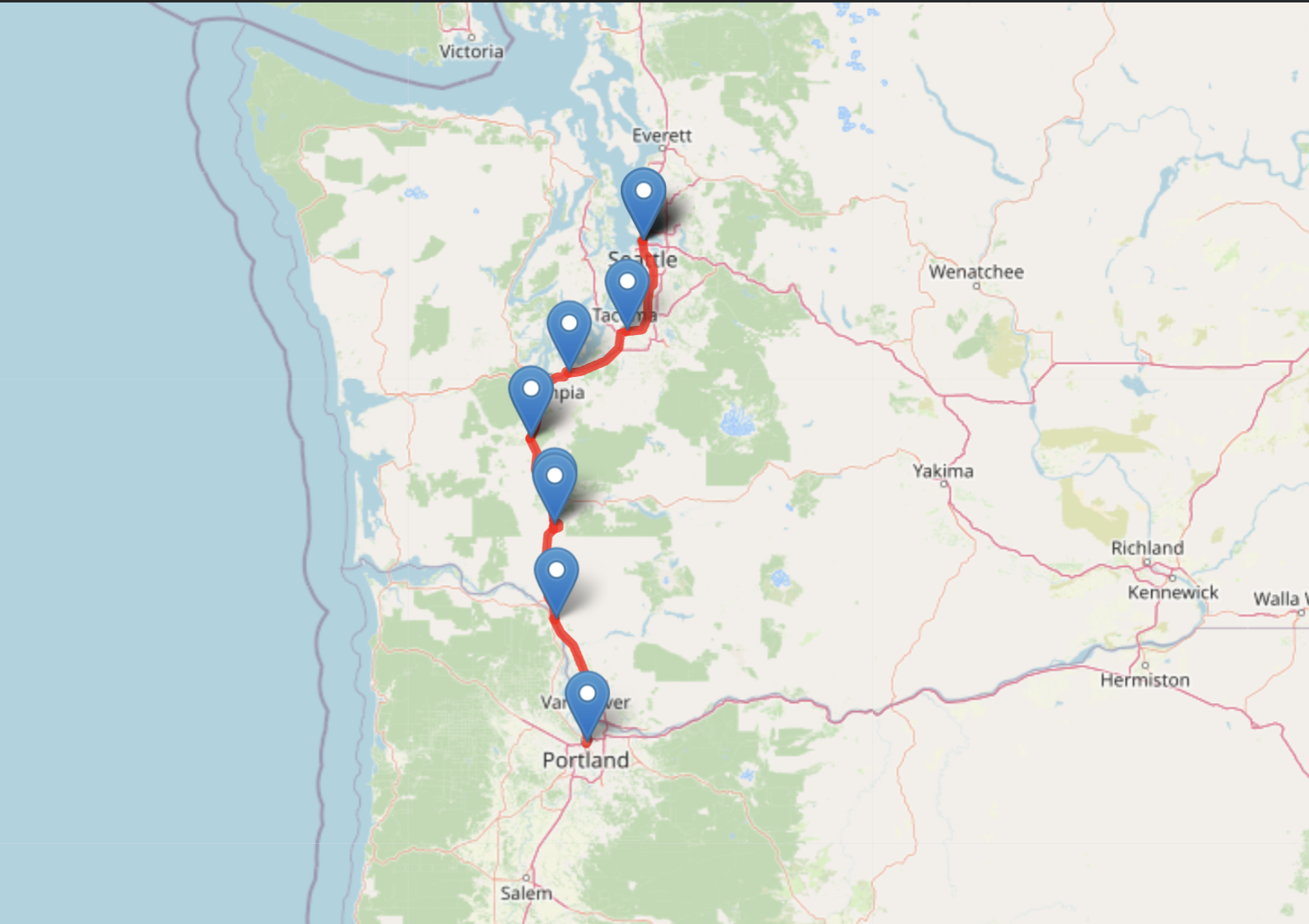
TRAR Trip Recommendation Output - Portland to Seattle

The system generates interactive map visualizations showing the recommended route with Points-of-Interest marked along the path. The example above demonstrates a road trip recommendation from Portland to Seattle, highlighting how TRAR balances route attractiveness with destination quality to create an optimized itinerary.

Problem Statement

Traditional trip recommendation systems primarily recommend Points-of-Interest based on individual popularity, overlooking the appeal of the routes between destinations. However, certain routes—such as scenic mountain passes, coastal drives, or highways with unique characteristics—can significantly enhance the overall travel experience. TRAR addresses this gap by integrating both POI attractiveness and route quality into a unified recommendation framework.

System Architecture

TRAR operates through a four-part framework:

Data Acquisition and Preprocessing

The system leverages real-world APIs to collect comprehensive travel data:

  • Foursquare API: Provides detailed POI attributes including names, geolocations, categories, and popularity metrics
  • OSRM API: Retrieves accurate route geometries and travel time estimates between POIs
  • folium: Used for visualizing route itineraries on interactive maps

Graph Construction

A travel graph is constructed where:

  • Nodes represent Points-of-Interest (POIs)
  • Edges represent routes between POIs, weighted by travel time
  • The graph is enriched by connecting POIs based on proximity and sampled waypoints along main routes

Attractive Route Discovery and Scoring

For each route in the graph, multiple metrics are computed:

  • Gini Coefficient: Measures the inequality in popularity of incoming routes to each POI, capturing route diversity
  • Gravity Model: Evaluates route attractiveness based on POI popularity, route popularity, and distance
  • SVM-based User Modeling: Uses Support Vector Machines from scikit-learn to model user preferences in a multi-dimensional category space

The overall scoring function combines:

  • POI rating
  • Similarity between POI features and user preference vectors
  • Attractiveness bonus for routes exceeding a threshold

Trip Recommendation Engine

The final itinerary is generated using a greedy search strategy with score-based selection. Candidate POIs are evaluated based on a weighted ratio of total experience gain (from both POI and route) to travel plus stay time. The algorithm continues to add stops as long as promising candidates exist, resulting in richer itineraries that maximize user experience.

Experimental Analysis

A comprehensive experimental evaluation was conducted by systematically varying key parameters to assess their impact on computational runtime and itinerary quality:

Waypoint Count Analysis

Experiments varying waypoint count from 4 to 32 revealed a clear trade-off: increasing waypoints yields richer POI coverage and potentially more attractive itineraries, but at the cost of higher computation time during graph construction.

POI Weight Optimization

Analysis of the poi_weight parameter (varied from 0.8 to 5.0) demonstrated the existence of an optimal "sweet spot" around 1.8 to 2.0, where the experience score is maximized by balancing POI quality with travel cost. Higher weights favor more stops but increase overall trip duration.

Maximum Connections per POI

Varying the maximum connections per POI revealed that intermediate settings (around 10 connections) strike the best balance between computational efficiency and itinerary quality. Excessive connectivity introduces redundancy and diminishing returns, while too few connections limit route diversity.

Key Findings

The experimental analysis revealed several important insights:

  • Optimal Parameters: A waypoint count between 8 and 10, a POI weight of approximately 1.8 to 2.0, and intermediate connectivity settings maximize overall experience score while keeping computation time within acceptable limits
  • Trade-offs: There are clear trade-offs between data richness and computational overhead, requiring careful parameter tuning
  • Route Quality Matters: Incorporating route attractiveness significantly improves recommendation quality compared to POI-only approaches

Technical Implementation

The system is implemented in Python using:

  • scikit-learn: For SVM-based user preference modeling
  • NumPy: For mathematical operations and graph computations
  • requests: For API interactions with Foursquare and OSRM
  • folium: For interactive map visualization

Future Directions

Several promising research directions remain:

  • Adaptive Parameter Tuning: Dynamically adjust configuration settings based on user feedback or real-time data
  • Advanced Search Strategies: Integration of non-greedy techniques such as beam search or reinforcement learning
  • Data Enrichment: Incorporation of additional POI datasets and real-time user-generated data for more nuanced understanding of preferences

Academic Context

This project was developed as part of ECE 570 (Machine Learning) at Purdue University, focusing on the practical application of machine learning techniques to real-world recommendation problems. The work extends existing research in personalized trip recommendation by providing a more streamlined framework that balances computational efficiency with recommendation quality.